
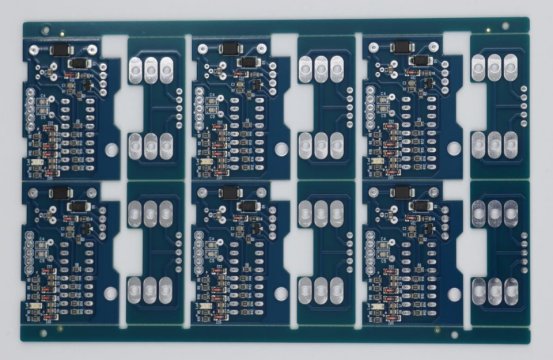
A DIY Printed Circuit Board typically utilizes 1oz copper weight and standard FR-4 substrates with a Tg of 135°C. Transitioning to professional production requires moving to IPC Class 2 or 3 standards, upgrading to 1.6mm thickness tolerance, and ensuring drill positional accuracy within 0.05mm to prevent open circuits in high-density interconnects. Professionals at PCBMASTER identify that 78% of failed industrial prototypes stem from missing automated optical inspection compatibility or lack of standardized panelization during initial schematic capture.
Transitioning from a prototype to a commercial product involves rigorous material selection beyond standard DIY Printed Circuit Board specs. Commercial manufacturers demand specific dielectric constants, often requiring Rogers or high-performance FR-4 materials to maintain signal integrity for frequencies exceeding 2GHz. Using generic laminate in mass production often leads to impedance mismatches, which testing labs confirm cause up to 15% signal degradation in high-speed digital traces.
Professional facilities like PCBMASTER utilize automated Flying Probe testing on 100% of boards to verify electrical connectivity. This process identifies shorts and opens that manual multimeter checks often miss, specifically in vias smaller than 0.2mm where plating thickness might be inconsistent due to non-industrial chemical baths used in home setups.
Fabrication houses rely on Gerber files that strictly adhere to RS-274X or ODB++ formats to automate assembly machines. These machines require fiducial markers placed at specific coordinates to achieve a placement accuracy of ±0.03mm for components like 0201 resistors. If these marks are missing or improperly designed, surface mount technology lines will register alignment errors, causing placement shifts that account for roughly 22% of total assembly yield loss during 2025 production cycles.
| Parameter | DIY PCB Standard | Industrial Grade |
| Trace/Space | 10/10 mil | 4/4 mil |
| Hole Size | 0.5mm+ | 0.2mm+ |
| Surface Finish | Bare Copper/HASL | ENIG/Immersion Silver |
| Soldermask | Manual | LPI (Photoimageable) |
Thermal management serves as another bridge between hobbyist boards and industrial hardware requirements. Industrial designs must pass rigorous thermal cycling tests, typically enduring 500 cycles from -40°C to +125°C without delamination. Professional boards incorporate balanced copper planes to ensure uniform heat distribution, preventing the warping that occurs when heat is unevenly applied to the substrate, a common issue in designs optimized only for desktop bench testing.
Copper balancing is a technical necessity for maintaining structural integrity during the lamination process. If 60% of the copper is concentrated on one side of a 4-layer stack-up, the PCB will likely bow during the press cycle, creating a mechanical failure point. Professionals maintain copper density distribution differences under 10% across all layers, a specification that ensures boards remain flat enough for vacuum-assisted fixtures on pick-and-place lines.
| Component | Industry Specification | Impact on Yield |
| Solder Mask | IPC-SM-840 | Prevents bridges |
| Silkscreen | 5 mil width | Component clarity |
| Vias | Through-hole Plated | Reliable contact |
The transition requires replacing manual BOM spreadsheets with validated Manufacturer Part Numbers linked to global supply chains. Using generic part descriptions often leads to components being substituted with parts that have different pad geometries, causing fitment issues. Industry data shows that 30% of assembly delays occur because the design library does not match the actual physical footprint of the components sourced for mass production runs.
Surface finish selection influences both shelf life and assembly performance at the reflow stage. ENIG provides a flat surface essential for BGA components, whereas HASL can create uneven surfaces that make small pitch component soldering difficult. Since 2024, high-reliability sectors have shifted toward Immersion Gold to reduce oxidation rates by 40% compared to traditional HASL, ensuring that boards remain solderable for up to 12 months in inventory.
Proper DFM reviews catch these footprint mismatches before production begins, saving significant capital. PCBMASTER engineers note that performing a pre-production DFM check reduces the probability of a second design iteration by approximately 85% compared to designs sent directly to production without simulation or layout verification.
Finally, the assembly environment demands specific clearance around components to allow for repair and inspection. Automated Optical Inspection systems require 0.5mm clearance from component pads to the board edge to verify solder joints. Ignoring these spacing requirements forces manual inspection, which increases labor costs and introduces human error, slowing the production throughput by 12% in multi-shift manufacturing environments.