
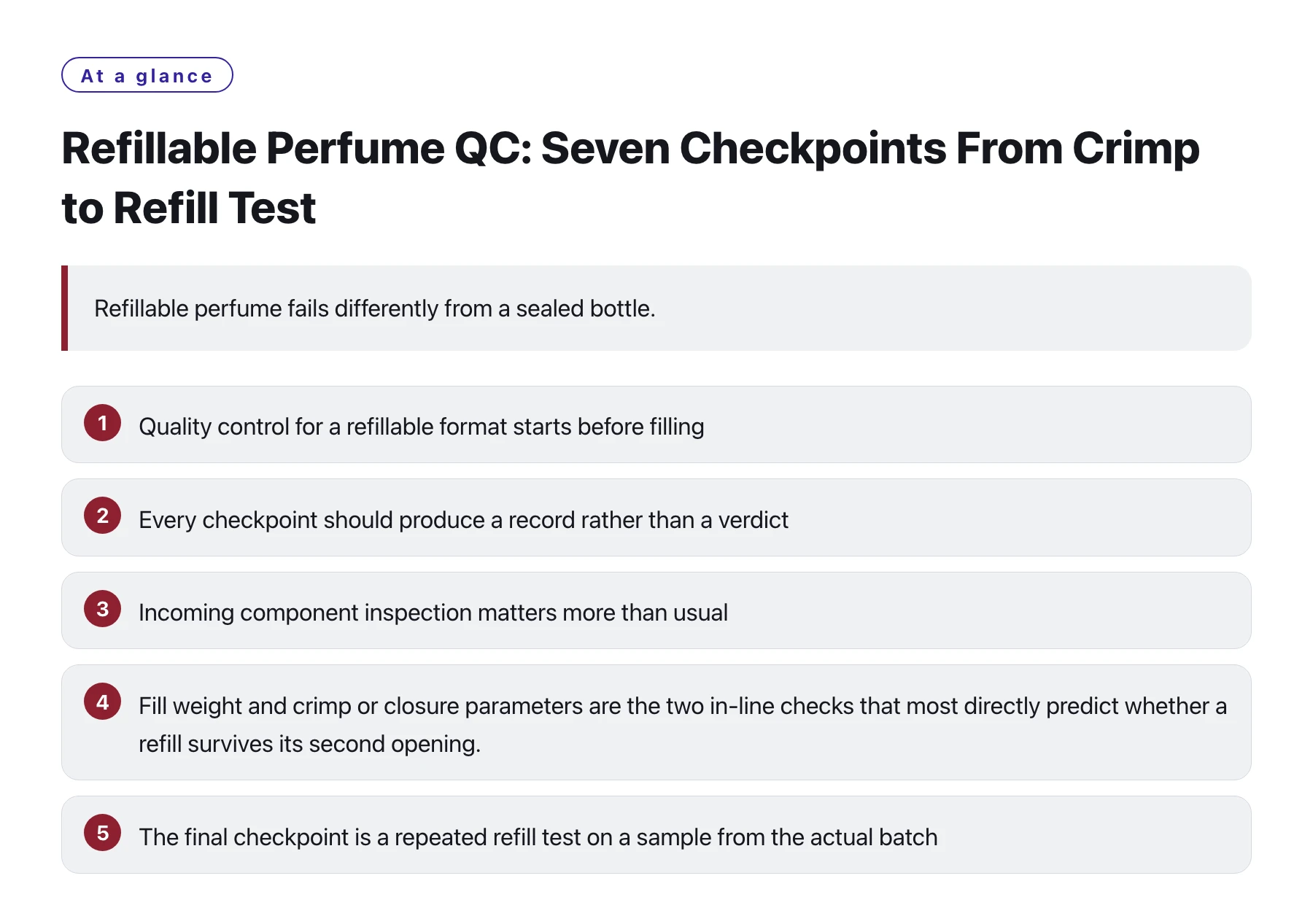
Refillable perfume fails differently from a sealed bottle. The failure is not usually the fragrance; it is the closure that no longer seals, the refill that no longer fits, or the label that will not survive a wet hand. Seven checkpoints, placed from compounding through to a repeated refill test, catch those problems while they are still cheap to fix. Placed later, the same problems arrive as customer complaints.
Key takeaways
- Quality control for a refillable format starts before filling, because the compatibility of the fragrance with the refill material cannot be inspected at the end of the line.
- Every checkpoint should produce a record rather than a verdict, so that a later batch can be compared against the same evidence.
- Incoming component inspection matters more than usual, since a small variation in a moulded thread becomes a leak once the closure is used repeatedly.
- Fill weight and crimp or closure parameters are the two in-line checks that most directly predict whether a refill survives its second opening.
- The final checkpoint is a repeated refill test on a sample from the actual batch, not on a hand-built prototype.
Most quality plans are written for a single-use product. A refillable system breaks that assumption, because the unit is designed to be opened, closed and replaced many times, and each of those actions is an opportunity for a defect that no end-of-line inspection will see.
The plan below is deliberately ordered as the product moves. It starts with materials, passes through filling and sealing, and ends with a test that only makes sense for this format: taking a finished unit and refilling it repeatedly.
The perspective is the one a quality manager would take when a brand asks what will be checked and what will be kept. The answer should be seven records, not seven assurances.
Seven checkpoints, in the order the product moves
- Material compatibilityThe approved fragrance is tested in contact with the refill material and the seal before any filling takes place, so an incompatibility is found in a laboratory rather than on a shelf.
- Incoming component inspectionMoulded parts are checked against the drawing on dimensions that matter to sealing, including thread and collar geometry, not only on appearance.
- Bulk releaseThe compounded fragrance is released against its specification, with the batch record retained so that the fill can be traced to the material it came from.
- Fill weight and volumeDeclared volume is verified against the agreed tolerance, and the result is recorded as a distribution rather than a single pass or fail.
- Closure and crimp parametersTorque, crimp depth or snap engagement are measured and logged, because these settings decide whether the seal survives repeated use.
- Visual and label controlFinished refills are checked for fill level, labelling position and print quality, with attention to how the label behaves on a surface that may become wet.
- Repeated refill testUnits drawn from the finished batch are opened and closed through the agreed cycle count and inspected for leakage, cracking or loss of function.
What each checkpoint catches, and what it costs to skip
| Checkpoint | Failure it catches | Cost of skipping it |
|---|---|---|
| Material compatibility | Fragrance attacking a seal or reservoir material | Returns, and a reformulation after launch |
| Component inspection | Thread and collar variation between moulding batches | Leaks that appear only after repeated use |
| Bulk release | A batch that does not match the approved reference | A whole production run questioned at once |
| Fill weight | Underfilled refills and overstated claims | Rework, or a compliance problem on the label |
| Closure parameters | Seals that pass once and fail on the second opening | Customer complaints that are hard to reproduce |
| Label control | Misplaced or damaged labels on a small pack | Manual rework and delayed dispatch |
| Repeated refill test | Everything the earlier checks could not predict | A format problem discovered by the customer |
Note where the costs land: the early checkpoints cost laboratory time, and the late ones cost a launch.
Three habits that make the checkpoints hold
A checkpoint is only as good as the record it produces. Testing providers in the cosmetics and personal care sector routinely group stability, compatibility and microbiological work into a documented scope, which is a useful model: the value is in the documentation as much as in the test [1].
The second habit is separating judgement from measurement. Where a safety assessment is required, it draws on scientific opinion work of the kind published by the European Union's Scientific Committee on Consumer Safety, and the inputs to that assessment have to be traceable [2].
The third is watching the sector rather than only the supplier. Industry coverage of personal products follows packaging and production quality issues as they emerge, and it is a cheap way to learn which formats are causing trouble elsewhere [3].
Sample from the batch, not from the shelf
The unit used for the repeated refill test should come off the line, from the batch that will ship. A prototype assembled by hand proves that the design can work; it does not prove that the line produced the same thing.
This is the difference between validating a design and releasing a batch, and on a refillable format the gap between them is where most surprises live.
Write the cycle count into the order
How many times a refill is opened and closed before it is considered worn out is a specification, not a preference. Writing it into the purchase order turns the final checkpoint into a pass or fail test rather than a discussion.
The count also tells the brand what the customer is being promised, which matters for returns policy and for the claims made on the pack.
Decide who holds the records
The brand should be able to obtain the batch records it needs, and a partner that already operates a documented release system is easier to work with. Checking what a factory's quality system actually issues is a reasonable part of screening, and it is one of the checks that matter before signing a contract.
The published scope at xuelei.com is a starting point for that conversation, since it indicates which steps a manufacturer performs in-house and which it coordinates.
For premium positioning the bar rises again, because a pack that looks handled after the second refill undermines the price. That is the practical meaning of premium fragrance production partner language, and it is a quality claim before it is a marketing one.
Where a brand wants the whole sequence under one responsibility, from compounding to sealed unit, a partner that presents itself as a factory that handles fragrance R&D and production is the simpler option, provided the quality records are still requested explicitly.
One question exposes the weakest part of most refillable quality plans: show me the record for a unit that was refilled ten times. If the answer describes a prototype rather than a shipped batch, the final checkpoint is aspirational rather than real.
Sources
- SGS: Cosmetics, Personal Care & Household Testing —— Testing, inspection and certification services for cosmetics and personal care, including microbiological, stability and safety testing aligned with cosmetics GMP.
- EU Scientific Committee on Consumer Safety (SCCS) —— The EU scientific committee that issues opinions on the safety of cosmetic ingredients, including fragrance allergens and their labelling thresholds.
- HAPPI — Household & Personal Products Industry —— An industry magazine covering the household and personal care market, including fragrance, formulation and packaging.
Frequently asked questions
How many refill cycles should a quality plan test?
Enough to represent the product's intended life with margin, and the number should be written into the specification so the result is a pass or fail. The exact figure is a commercial decision, but it must exist before testing starts.
Why is incoming component inspection more important on a refill?
Because the closure is a working part. A slight variation in thread or collar geometry can pass a visual check and still leak after the third opening, and by then the units are filled, labelled and packed.
Should the brand ask for batch records on a first order?
Yes, and it is easier to ask before the order than during a problem. A supplier that maintains records will show a template immediately; one that does not will explain why records are not usually needed.
Can compatibility testing be replaced by a longer stability test?
No. Stability describes how the product changes over time; compatibility describes how the product and the pack affect each other. A refillable format needs both, because the pack is in repeated contact with the customer as well as the fragrance.
What is the most commonly skipped checkpoint?
The repeated refill test, because it looks like a design exercise rather than a production check. It is also the only checkpoint that reflects how the customer will actually use the product.